July 2026 – Listen Here
Twenty-seven days.
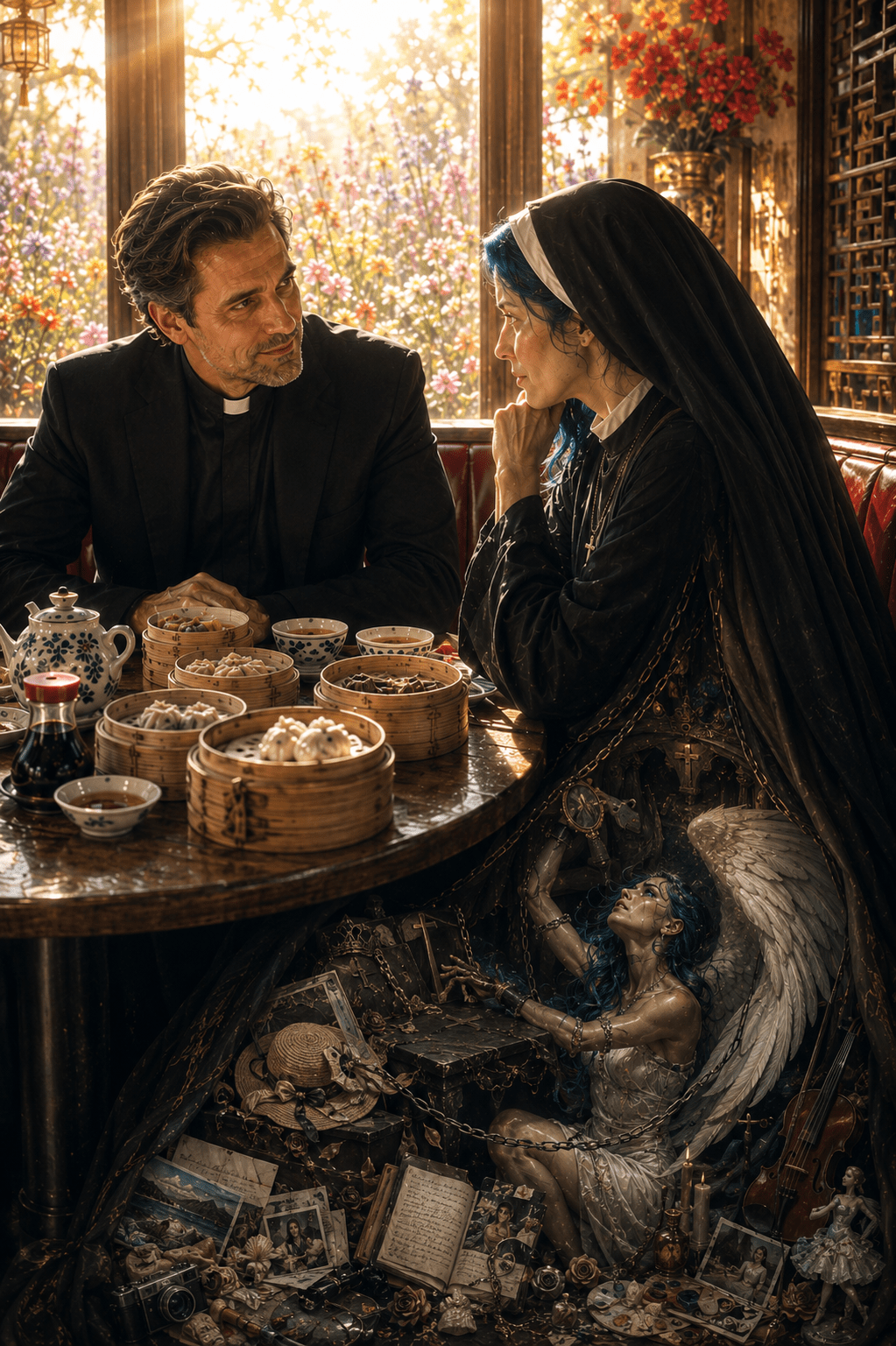
Twenty-seven days had passed since she folded her tattered heart into careful quarters and carried it beyond the habitable world, to a monastery so remote it seemed to stand at the very edge of God’s creation, where pain itself might finally grow bored and cease its pursuit of her. There to bury it among sputtering candles and weathered stones and never speak of it again.
Thirty-two had passed since she last surrendered her body into another’s hands and discovered, with cold dread, that it had become a mechanical thing, performing all the customary gestures of desire while her soul stood elsewhere and waited only for the ordeal to end.
But in verity, she had begun disappearing long before she ever crossed the monastery gates.
Life had become almost intolerable in its caprice. Love had become a sacrificial knife, drawing blood precisely where it had once offered sanctuary. Joy itself had grown suspect, as though happiness were some forbidden vintage from which she had drunk too deeply and for which heaven had now come to exact its miserly tithe.
And so, believing herself somehow broken beyond ordinary repair, and no longer trusting her own heart to survive another disappointment, she had come to the fortress and spoken the three vows she imagined might save her from herself: silence for the mercurial mind, chastity for the feral flesh, and solitude for the wounded heart.
She wrapped herself in black wool as another woman might don mourning weeds and tucked every brilliant sapphire curl beneath a white wimple, effacing every trace of the vivid woman she had once been. Behind foreboding stone walls and corridors draped in cobwebs, she laid the tattered remnants of her life upon the altar of an unseen God and willingly entered her own sepulcher.
Beyond the abbey gates lay the perilous country of the living: a realm of laughter, adventure, music, and every small sweetness she could no longer bear to touch.
She had not entered the monastery because she wished to find God. She had entered it because she no longer trusted herself with hope. Because she wished to die, for the pain to end.
Perhaps she was merely receiving the proper penance for the appalling crime of joy. For daring to love, and worse still, for believing that this time happiness might remain.
Most mornings she awakened already weary, as though, like Jacob, she had spent the entire night wrestling angels in darkness and had emerged from the encounter crippled, her depression unconquered and her blessing nowhere to be found.
Most nights she kept vigil before the candles until their wax collapsed into pale, opaline pools, wondering whether the Succubus within herself had always been the source of her suffering, and whether, if she buried that ravenous creature deeply enough, the world might finally cease demanding pieces of her heart.
Her shoulders ached beneath invisible reliquaries filled with old sorrows. Her chest carried the leaden heaviness of a heart grown exhausted by its own repeated martyrdom.
Even beauty no longer reached her.
Once she had been a siren of sapphire hair and flowers tucked behind her ears, a woman who delighted in silk, moonlight, and curious things gathered from distant places. She laughed too loudly, loved impiously, and found godliness in every mysterious and ephemeral thing. She adorned herself not for admiration, nor to entice, but because existence itself had once seemed worthy of celebration. She had once believed herself worthy of participating in the splendor of creation.
Now she scarcely recognized herself. Her cheeks looked hollow, her eyes sunken and bruised. Numbness had settled around her like a beloved shroud. Despondency had stolen even her vanity. She no longer wondered if she appeared youthful. She no longer wondered if she was desirable. Those concerns belonged to the living.
She wondered only whether the glorious goddess she had once been had finally perished, and whether she ought to grieve her passing or thank heaven for finally silencing her.
She no longer possessed the resilience to do anything beyond the grim liturgy of surviving another day.
Yet her community and the Priest refused to let her disappear. For he remembered.
He remembered the woman she had once been: carnal, arcane, and radiant with some faintly Dionysian splendor, as though temptation itself had taken human form and grinned.
He remembered the forbidden ambrosia forever clinging upon her tongue and the curious, effortless sovereignty she possessed – the sort of enchantment that made both men and gods forget their own names as they fell to their knees before her throne.
Her laughter had once sounded like music heard through candlelight. Her smile had always promised salvation and ruin in equal measure, and there had been moments when one could scarcely discern where sanctification ended and catastrophe began.
The black habit obscured her form, but it could not transfigure her nature. Could fortress walls halt a consuming wildfire? Could tear-soaked prayers persuade the moon to forsake its course? Could vows murmured like funeral rites truly murder the winged abomination chained within the crypt of her soul?
Pain was the price exacted from those who had loved the world too extravagantly. For more than once, she had been utterly intoxicated by existence itself.
She had found emanation in the brush of lips, in the press of pulsing bodies and stolen glances, in moonlit orgies and wandering hands. She had worshipped on her knees before Titan gods and spoken forbidden names beneath the stars. She had collected adventures and lovers as though life were a lavish feast and she intended to relish every offering placed before her.
And behold where her appetites had delivered her: to exhaustion, to loneliness, to a heart so bruised it could no longer imagine opening its hands to the world again. Perhaps heartbreak was simply the tax levied upon women foolish enough to believe that joy should be theirs.
The Nun feared the woman she had once been – the woman who had possessed the audacity to look upon the world and desire all of it. The woman who had once mistaken ecstasy for a kind of holiness.
She feared the temptress. The Succubus. The insatiable and nearly feral woman who had believed herself worthy of delight. For such creatures were born for tragedy. No gentle fairytales are written for the daughters of the Pit.
And yet, on certain nights, when moonlight spilled through the stained glass and glazed her skin in emerald and ruby and gold, the Sister would kneel alone before the altar and feel her pulse – faint but stubborn – fluttering beneath her vows.
The candles flickered.
The incense curled heavenward.
Deep within the sepulcher of her soul, locked beneath lamentation and bound in chains of unanswered prayer, the wounded Succubus stirred, her feathers giving the faintest rustle against the unforgiving stone.
The Nun prayed with all the fervor of the desperate that it might never rise again.
And perhaps it was for this very reason that Providence refused to permit her solitude.
The Priest invited her to break bread with him upon a balmy afternoon. He had sent several entreaties, each carrying the subtle persistence of a man who knew how likely she was to retreat. For if she remained silent long enough, he would eventually appear at the monastery gates himself, sunlight upon his shoulders and concern in his eyes, asking after the Sister who had repressed herself.
She could not bear the thought of him standing there, looking upon the sepulcher she had mistaken for sanctuary, and so, with a groan, she agreed to meet him.
The day itself seemed almost indecently magnificent.
The air was heavy with the scent of sun-baked earth and blooming esperanza. Crepe myrtles spilled their fuchsia blossoms like extravagant confetti while hummingbirds darted among the coral petals of flame acanthus.
Everything outside the monastery appeared too vivid, too exuberant, too animated. The beauty of it felt almost obscene to her, as though the world itself had the audacity to remain lovely while she had become a mausoleum.
She had come arrayed in mourning, every sapphire curl hidden beneath the severe linen of her wimple, every bright and vivid fragment of herself disciplined beneath somber vesture, while the world persisted in its indifferent revolutions, as though her loss had altered nothing at all. She wanted to resent the flowers for their shameless abundance and the sun for laying its golden hands so tenderly upon the world when she herself felt emptied and cold.
The priest did not ask her to be cheerful. He did not tell her she looked well when she did not, nor did he attempt to persuade her that leaving the monastery was proof of some recovery she did not feel. He simply sat across from her and broke bread, receiving her presence as though it were sufficient in itself.
At first, they spoke of small and harmless things: books and friends, shifting careers, distant kingdoms and tantalizing cultures. Yet even such commonplace topics possessed an uncanny quality, as though she had spent so long in solitude that she had forgotten the very music of companionship.
Disconsolation had made her eyes traitorous things. They filled without warning, blurring the priest’s face and forcing her to lower her gaze toward her plate or busy her hands with tearing bread into smaller and smaller pieces. Again and again she tried to gather herself, only to feel another wave rise inside her.
She had not intended to confess anything. She had meant to endure the meal politely, offer a few careful answers, and return before the shadows lengthened across the monastery floor. Instead, the silence between them became spacious enough for the truth to enter.
Some of what lay upon her heart escaped her in broken fragments. She spoke of exhaustion and disappointment. She spoke of how tired she had become of carrying consequences that did not belong to her, of how deeply it had wounded her to give and give only to find her loyalty questioned when she finally chose herself. Some confessions she managed to voice, but others reached the edge of her tongue and stopped there. Those she swallowed, pressing them into obscure chambers where shame and thirst lay imprisoned together.
The priest listened without trying to pry open what she would not offer. He never asked for more than she was willing to give, never reached for gossiping tidbits, and never treated her sorrow as an inconvenience he had been tasked with solving. He did not offer bright little lessons meant to make the darkness more comfortable for him. He simply remained seated across from her, steady and attentive, as though every tangled gnosis she laid between them was worthy of reverence rather than correction, and need not be diminished or explained away in order to be endured.
That kindness became almost unbearable.
At moments, she felt her anguish swelling so violently that it might swallow her whole there at the table. She wanted to rise abruptly, gather her skirts, and flee. She longed for the cool reclusiveness of the monastery. Within those shadowed rooms, no one watched her eyes fill with tears. No one listened for the tremor in her voice or witnessed the immense labor required to merely impersonate the living.
Solitude asked nothing of her. Not to smile and not to hope.
Being seen was far more dangerous than being desired. To be seen was to be remembered, and to be remembered was to risk resurrection.
The Priest still regarded her as though the vivid and beautiful woman beneath the habit only required the gentlest nudge of encouragement to awaken once more.
The thought filled her with almost superstitious dread.
For awakening would require her to live again. And living meant risking wonder. Risking hope. Risking love. Risking heartbreak.
She was so very tired.
The realization made her wish to retreat further still into herself. She pulled the dark wool a little tighter around her.
“I am sorry,” she murmured at last, staring down at her hands.
The priest’s expression softened with attentive concern.
“For what?”
How could she explain what seemed so painfully obvious? For the tears. For arriving still carrying all the despair she had hoped to bury behind monastery walls, for being a woman who had once been vibrant and expansive, and who now sat before him like a wraith, unable to keep sorrow from breaking through her eyes.
The words felt absurd the moment they left her lips, yet she could think of nothing else to offer him.
“Flee. Retreat. Hide.” The words rose within her with the frantic desperation of a cornered animal. “Return to safety! Back to darkness.”
She didn’t want to be seen. Ashamed of her vulnerability. Ashamed that he had glimpsed beneath the careful mask she had constructed. Ashamed of the faltering words that had escaped her cracked lips and the stricken, humiliating evidence that her heart remained capable of such desolation.
So she merely shrugged.
The Priest did not tell her she was fine, nor did he insist that she had nothing for which to apologize. His expression remained serene, his voice untroubled. He merely refused to regard the weight of her confession as too heavy to be laid between them.
The Nun felt wrung hollow, exhausted by speaking and equally exhausted by all she had left unsaid. Her laughter had sounded alien to her own ears, fragile and forced, offered for the sake of a precious friendship rather than born from genuine joy.
Across from her, sunlight streamed through the windows and lay across the Priest in golden bands, illuminating the chiseled planes of his face and the formidable breadth of him beneath linen and shadow. There was something profoundly unfair in the juxtaposition of such physicality and such confidence, as though he belonged to those ageless murals where saints and executioners often wore the same face. Time and laughter had left the faintest traces beside his eyes, softening what might otherwise have been a severe countenance and rendering him all the more dangerous for it.
The linen of his shirt stretched across shoulders broad enough to bear burdens not his own, and his forearms, revealed where his sleeves had been carelessly rolled, spoke not of idleness or scholarly frailty but of a man who had spent a lifetime working with his hands. There was leonine authority in him, reposed and unboastful, hidden beneath benignity like the angel set before Eden with a flaming sword.
At last, their copper cups lay empty upon the table, stained with the remnants of wine and summer conversation. The Priest neither pressed her to stay nor sought to delay her return to the monastery. He simply offered her a few moments of repose within his quarters before she departed, speaking with the dulcet cadence of one accustomed to receiving confessions and tending wounded souls.
There was no secret expectation, no hidden covenant concealed beneath the offer.
He observed gently that her shoulders had remained drawn tight throughout the meal, and suggested that perhaps he might ease some of the strain, but only if she wished.
Nothing more. She believed him. She knew his heart too well to hear seduction in the offer.
He had never pressed against a boundary she had drawn, nor treated tenderness as a debt to be repaid. His invitation carried no claim upon her body and no quiet campaign against her vows. It was merely care – a small offering of mercy made to a weary woman by someone who could read suffering in the rigid line of her neck and the tight set of her shoulders.
And perhaps that, more than anything else, frightened her.
For heartbreak, expected abandonment. Pain expected demands. Sorrow expected every kindness to arrive, concealing its fangs.
The Nun hesitated at the offer. She hated the ache it awakened within her – the treacherous peregrination for the solace of human touch.
It seemed such a pitiful and painfully human need. To be comforted. To be held. To surrender one’s exhaustion, if only briefly, into the keeping of another. The homesickness struck her with almost physical force, and she resented it with all the bitterness of self-reproach.
For touch reminded her that she still possessed a body capable of longing. It reminded her that beneath the raven livery and ventured prayers, beneath the numbness and self-imposed penance, she remained horribly, inconveniently sentient.
Oh, but her body remembered what her heart was trying so adamantly to forget.
It remembered calloused hands caressing the sensitive fullness of her ample bosom and inquisitive fingertips tracing idle patterns down the plane of her abdomen. It remembered clothing scattered with abandon, the intoxicating weight of another’s body, and stars bursting behind tightly shuttered eyes.
Her lips, traitorous things, remembered bruising kisses. The unmentionable idolatries murmured like profanities against the delicate shell of her ear, as though she were something precious and perilous, prey gathered close only to be devoured.
And she despised it. She had absconded to the monastery to bury such memories.
To bury the Succubus who had once found Elysian in the fevered pulse beneath another’s flesh, in tangled limbs and ambrosial mouths, in the hedonistic corruptions of flesh and profane bodies entwined until all distinction dissolved and one could no longer discern where one ended and the other began, and who had dared to call such things worship.
To extinguish the heart that had loved life too greedily, which had reveled in its own appetites and repeatedly offered its throat to sorrow as though heartbreak itself were a sacrament.
Yet here, in the tranquil aftermath of a midday meal, she found herself mourning a simple and sacred human touch. The realization felt less like hope and more like betrayal.
Another appetite.
Another small, breathing remnant of the wondrous creature she had labored so resolutely to murder. The dead, it seemed, had refused to remain relegated beneath the earth. And she resented it with every chain of her vows.
No.
No, no, no.
What if the fragment she feared still lived?
What if the Succubus yet slumbered beneath her ribs – the ancient temptress who had mistaken pleasure for prayer, indulgence for enlightenment? The creature who had knelt willingly before the altars of appetite and had mistaken pleasure for prayer, indulgence for enlightenment, and desire for divinity.
What if she still tarried there, patient and enduring as all primordial things are, sleeping within her sepulcher and waiting only for the smallest invitation?
The thought sucked the breath from her lungs and sent her heart stumbling painfully against her breastbone.
For if that Succubus yet lived, then she had failed utterly in the task she had set herself. She had not succeeded in killing her. There remained still more of herself to deny, more dangerous appetites to starve, more of that sensate woman to bury beneath habiliments and prayer.
And that realization felt unbearably cruel.
For a long while, she remained silent, her hands folded tightly within her lap while the late afternoon sunlight stretched long and golden across the table. A back rub, he had promised. Nothing more than a few stolen moments away from the oppressive clamor of the restaurant, a small kindness asking nothing in return.
At last, fighting against every instinct that urged her toward retreat, she gave the smallest of nods.
The Priest’s quarters were neat and homey, the late afternoon sun spilling through the windows in long shafts of honeyed light that painted the wooden floor in gold. Dust motes drifted lazily in the air, and somewhere beyond the walls she could hear the distant murmur of the world continuing on without her.
The Priest settled comfortably behind her upon the bed, his long limbs bracketing her on either side, his back resting lightly against the headboard. His hands came to her shoulders with the same composed deference one might offer a wounded bird, as his thumbs pressed softly into the rigid knots that had taken up residence within her.
She did not flinch.
Pain was nothing to her.
She had long since become a student of suffering. Months of smoldering embarrassment, anticipatory grief, sleepless vigils, and silent resignation.
She had carried all of it within her body for so long that she no longer remembered what it felt like to exist without it. The tension had become part of her flesh, settling into her shoulders and jaw and spine until she felt as though she carried the accumulated wretchedness of generations of women before her. Every failed love. Every abandonment. Every promise confessed in candlelight and mourned in solitude.
Slowly, his hands continued their ministrations.
A tremor moved through her.
Then another.
Her eyes fluttered closed, and despite every effort to stop them, tears escaped and slipped silently down her cheeks. She thanked heaven that the Priest could not see her face.
The room suddenly felt too stifling, too bright, too unbearably real.
For touch reminded her of living things.
It reminded her that she still possessed a body – body of flesh and pulse and breath. A body that had never truly followed her heart into the cenotaph at all.
No.
No, no, no.
She did not wish to remember such things. She did not wish to remember longing or want or the dangerous language of lust. Her vows rose silently within her, repeated with all the fervor of a prayer against possession.
Yet beneath his diligent hands she became acutely aware of herself: of her breathing, of the steady rhythm of her pulse.
Then came the ache. Familiar. Far below bitterness and prayer and self-imposed penance, deep within the catacombs of her heart, feathers rustled.
Claws scraped softly against stone.
The entombed shifted within the darkness.
Failure burned hotter behind her eyes.
Because she understood then, with rending clarity, that she had mistaken slumber for death. And now, awakened by nothing more scandalous than kindness, a single wing unfurled.
Then it’s twin.
The Sister bowed her head lower still as tears slipped silently down her cheeks. Her throat tightened. Her jaw clenched until a vein pulsed visibly at her temple.
She fought.
Gods, how she fought.
But the summons remained, haunting and hypnotic. It called to her from somewhere deep beneath the wreckage of herself, steady as a heartbeat and patient as ivy reclaiming a charnel house.
The Priest had done nothing.
There was no impropriety in his touch. No hidden hunger. No expectation concealed beneath kindness. His hands remained upon her shoulders, easing knots that seemed to resist even his patient ministrations.
She concealed her agitation, curling her hands into small fists and tucking them beneath her legs.
The Succubus stirred again.
The Sister drew a shallow breath.
Then another.
A baleful revelation settled over her like a funeral veil.
She could no longer tell where she ended and the Succubus began. She was no longer entirely certain that she remained sovereign mistress of her own body.
The Nun found herself moving, guided by forgotten instincts older than grief and far older than vows. In a single fluid motion, she turned within the sanctuary of his arms, her skirts spilling like midnight water as she settled across his lap, their faces just inches apart.
And then she became utterly still.
For one impious heartbeat, she could do nothing but stare.
The world seemed to tilt almost imperceptibly upon its axis, and time itself appeared suspended, as though heaven and hell alike had paused to witness what choice she would make.
Suddenly she became aware of everything at once: the rapid thunder of her own pulse, the impossible closeness of his chiseled jaw, the honed brawn of the body beneath her, and, beneath layers of wool and linen, the hardening and undeniable reminder that he remained a man of flesh and blood.
Her breath caught painfully in her throat.
She ought to move.
She ought to rise at once, gather her skirts, murmur some mortified apology, and seek refuge within the monastery walls before the interred creature could fully escape.
She ought to remember her vows.
And yet she remained exactly where she was.
Deep within the sepulcher, claws scratched sharply against stone, no longer content to endure the darkness.
For all her fears of succubi and sirens and daughters of the Pit, the revelation that unfolded before her in that moment felt infinitely more disquieting.
She was simply a stricken woman seated in the lap of a consecrated man.
Like a tempting serpent, the Succubus whispered:
“What if you are not monstrous?”
“What if your desires are merely another ordinary and bewildering part of being alive?”
Then perhaps she had not fallen. Perhaps she had not been depraved.
Why had she tried so vehemently to excise every wild and luminous part of her nature? Why had she attempted to veil her horns in white linen and call the masquerade holiness?
Was not Lucifer himself once called the Morning Star? Was he not said to have been among the most resplendent of Heaven’s creations?
If beauty and appetency were evidence of corruption, then why had God filled His creation with such exquisite things? Why had He fashioned breasts for adoration and cocks capable of reducing even the devout to susurrant supplicants? Why had He made the climax feel like transcendence and isolation feel so very much like dying?
The Priest did not move.
Though their breath mingled, though his hands rested lightly about her waist, he made no attempt to draw her nearer. He did not presume. Did not claim. Did not so much as tighten his hold upon her.
Instead, he remained perfectly still beneath her, constant as the stars, as though he understood that even the smallest movement might send her fleeing back into the sepulcher she had mistaken for sanctuary.
And so he waited.
As enduring as angels.
As inevitable as dawn.
Waiting to see whether she would choose once more to bury herself…or whether, at long last, she might allow herself to live.
Somewhere above them, the crucifix continued its silent vigil. The vows she had spoken rose within her memory with the solemn cadence of funeral bells: silence for the restless mind, chastity for the treacherous flesh, solitude for the wounded heart. Sacred words once uttered with heartbroken sincerity, spoken as final rites over the casket of the luminous and untamed woman she had condemned.
Yet as she sat within the sanctuary of his arms, she felt those vows loosening one by one, fraying like timeworn ribbons and slipping through her fingers like rosary beads, plinking and scattering across cathedral stone.
For the unsettling part of her understood that chastity had not begun to perish here, beneath the fond attention of his hands and the impossible comfort of his nearness. It had fractured long before flesh had entered the matter of it. It had fractured the moment she chose companionship over isolation and allowed herself, however briefly, to return to the communion of the living.
His body became the final sacrament, and with dreadful inevitability, the long-sealed doors of her catacomb yielded at last, their rusted hinges crying out in protest as the creature she had renounced unfurled her wings within the ruins of her soul.
Her hands found his shoulders, nails biting through the fabric as her breathing grew uneven. She dared not look him in the eye. A fierce shudder passed through her, and her hips began to undulate. Somewhere above them, the frescoed saints remained mute, and the crucifix watched with unblinking eyes.
Energy swelled through her, and the Sister’s throat tipped heavenward, her power perilously close to defiance as the profound knowledge finally overtook her.
She had not become a saint.
She had not become ash.
She had not succeeded in killing her true nature.
She had not become holy enough to extinguish her fire.
Clinging to him as though she might otherwise shatter, she was overwhelmed with the awful knowledge that she was being torn in two. One part of her still knelt dutifully before the austere altar of sorrow, while another – older, wilder, and infinitely more avid – burst from the tomb with fire upon her lips and resurrection at her fingertips.
The Nun’s movements became frantic, almost fevered, as she pressed herself against the Priest, clinging to him as though he were both salvation and damnation alike, pursuing that maledictory sweetness with all the desperation of the excommunicated reaching once more toward grace.
Her body remembered.
It remembered hunger.
It remembered rapture.
It remembered what it meant to burn.
Her nails dug into the Priest’s broad shoulders as the Succubus rose triumphant within her, selfish and yearning, using his body and the rigid outline of his trapped arousal as though he were the sacrificial lamb upon whose flesh her celibacy would finally perish.
Every lurid movement became an act of apostasy. Her release swept through her like consecrated fire through a long-abandoned cathedral, illuminating every derelict chamber she had tried so desperately to keep in darkness, every shuttered window, every dust-covered altar, every forgotten prayer. It poured through her in one great and ecstatic benediction, slick and glistening upon her tremulous thighs, as though every silenced hymn and every smothered hallelujah within her had suddenly burst into song.
The Priest did not utter a word. His hands remained steady upon her quivering waist, supporting her as she shook beneath the unbearable splendor of her own renaissance.
And for a long and shuddering moment, she remained there, suspended between heaven and hell, between perdition and resurrection, the evidence of her broken vows soaking silently through every layer of their clothing like the spilled wine of some blasphemous communion.
When at last she dared to draw a shuddering breath, his gaze lifted toward her with an expression so soft that it threatened to make her weep.
There was only the solemn recognition of one who had long suspected the dead were not truly dead. He looked upon her as one who had long seen not sanctity in her vows, but starvation.
He watched her as a priest might witness a miracle.
Or a heresy.
Perhaps both.
Embarrassment colored her cheeks. Her brows knit together in consternation; her habit had become utterly soaked, clinging heavily to her thighs. Internally, the Succubus smirked with knowing satisfaction. It had been the first true release she had known in many long months.
Yet no Hail Mary rose to her lips, nor any Act of Contrition, nor even the faintest petition for mercy. For she knew, with the absolute certainty of the excommunicated, that she no longer desired forgiveness.
The merest glimmer had touched the sequestered creature within her, and like Lucifer before the Fall, she had risen coruscating from her confines.
Her vows had become distant things.
Forgotten things.
Like prayers spoken in childhood and left behind with innocence.
And whether heaven counted this moment as apostasy or miracle no longer concerned her. She could not bring herself to repent the simple and numinous joy of existing.
Her wimple and crumpled black habit slipped from her shoulders and pooled on the floor like mourning garments at last cast aside, while the Priest’s stole lay abandoned nearby, its sacred embroidery bearing mute witness to every tender and profane sacrament.
For the next two hours, she prayed.
She prayed to every god she had ever known and to all those she had long ago abandoned. She prayed to forgotten gods whose names had crumbled into dust, to Titan gods who had ruled before the birth of memory, to nameless deities sleeping beneath moons older than mankind itself.
She prayed in languages she did not know.
Sunlight poured through the narrow windows of the priory in molten streams, catching upon her sapphire curls and tracing indefinable shadows across the elegant sweep of her twisting horns, while behind her vast wings seemed to unfurl in silhouette against the immovable stone. For one delirious and aureate moment, she no longer cared whether they belonged to angels or demons.
The bed beneath them became a sacrilegious altar upon which her body poured forth its wanton confession. The chamber resounded with the mingled music of breath and rabid movement and the thunderous percussion of bodies meeting in feral communion.
Again and again, the Priest possessed her naked body, each relentless thrust another act of sacrilege, driving his swollen crown within her until even this profanation assumed the aspect of an impossible benediction. Whether he violated the sacred or restored worship within it, neither of them could have said.
Beneath him, her body answered each assault with all the fervency of the faithful, receiving his christening communion as though it had been starved for it all its life.
Still, she called the gods by name.
The Priest moved like some preternatural servant sent forth by the Almighty Himself. There was an aura of the sovereign in him, and an inexorable and almost frightening essence, as though he had been fashioned for one singular purpose: to stand before mausoleums and pry open their tombs with his bare hands and command them once more into the agony and splendor of being alive.
With every strained sinew and inexorable movement of his strapping body, he compelled the Sister to witness the impious gospel she had chosen to deny – that her flesh had never been fashioned for martyrdom. That every supple and shiverous inch of her had been created to hunger, to burn, to rejoice in being claimed, for her wanton lips to part in helpless obedience, and for her body to arch in possessed abandon. No amount of penitential cloth, no intoned litany, no self-imposed penance could ever succeed in teaching her living flesh the discipline of the grave.
And now, with every remorseless thrust of his martial hips, he stripped every illusion from her.
The illusion that grief had made her holy.
The illusion that burying herself had ever been the same thing as peace.
The illusion that she had succeeded in killing the vivacious creature within her.
Again and again, he wrenched her from her sepulcher, forcing breath back into lungs that had forgotten how to sing and fire back into a heart that had mistaken numbness for peace.
One by one, they fell away beneath his smiteful certainty until nothing remained but the auroral and ravenous creature she had buried and mourned. She had never truly wished for death at all. She had wished only for the pain to end.
And for this brief and lambent span, there was no lingering half-life.
No mourning.
No vows.
Only fire.
Only breathe.
Only the agonizing splendor of being dragged, weeping and unwilling, back into life.
The Succubus within did not rise gently. She came furious at her imprisonment, furious at her abandonment, furious at having been condemned to darkness for the crime of flourishing. She rose with all the eldritch inevitability of a fallen deity reclaiming her desecrated shrine.
She was appetite incarnate. A creature who had always sought the sublime through beauty and ecstasy rather than denial.
The Priest did not avert his eyes.
Nor did he rebuke her.
Instead, his hand left crimson imprints upon the pale skin of her vulnerable backside, the marks flowering like holy stigmata or the broken seals of some ominous scripture. A priest and shepherd alike, he chastened and guided her toward remembrance, toward the sacred and hallowed truth he had known from the very beginning.
He watched her neither as a man witnessing sin nor even as one witnessing temptation, but rather as a confessor might witness a final conviction being dragged weeping from a penitent soul.
For he had known all along what slept beneath the black wool and vows.
He had seen starvation where she had named it holiness. He had seen mourning where she had called it devotion. He had looked upon the Nun and recognized the creature hidden beneath the habit long before she herself possessed the courage to do so.
Not a bride of Christ.
Never truly a bride of Christ.
But a glowing and insatiable thing born for altogether different altars.
He did not rescue her from herself. He merely refused to help her disappear. Every gasping breath became another portentous lesson: that she had mistaken her nature for her damnation.
The vaulted chambers of the sanctuary rang with the sound of a woman being sundered and remade all at once, while her grasping fingers sought anchor in the living world and her nails left their scarlet marks upon him, as though some frightened part of her worried that if she released him, she might simply dissolve back into sorrow.
Yet he remained. His palm met her tender flesh as though he fought not against her, but for her very soul; as though he had always known this moment would come and had merely waited beside the crypt with saintly patience for the dead to rise.
For the Nun had sought shelter within the monastery because she wished to die.
The Succubus had merely waited there within her tomb, golden eyes shuttered and her great wings wrapped tightly about herself, curled amid dust and the bones of abandoned dreams while the slow and echoing drip, drip, drip of subterranean waters marked the passing time.
Waiting for the proper hour.
Waiting for emptiness to exhaust itself.
Waiting for someone foolish enough to remind her what it felt like to brim with vibrant incandescence.
And the Priest…
The Priest had simply opened the door.
How terrifyingly easy it had been to mistake obliteration for virtue.
Her throat burned. Her body quivered with exhaustion and bewilderment, every nerve newly awakened, and yet she felt strangely light.
The Priest had become a specter far more dangerous than a man.
Punishment and salvation. Executioner and redeemer.
The hand at her throat felt like a sacrament administered by some wrathful Old Testament god, and for one rending heartbeat she ceased to belong even to herself, her next breath no longer hers to claim but his to grant or deny.
And some remaining fragment of her soul rejoiced in it. Relished the sublime deliverance of surrender.
Loved the fatal certainty of placing her very life into the Priest’s hands. For one terrifying moment, he held her existence within the palm of his hands, her blood singing just beneath his fingertips. Her vision darkened at the edges, stars bursting behind her eyes like constellations newly kindled beneath cathedral ceilings, and a profound peace washed through her.
Her body bowed helplessly beneath the force of it while her limbs went limp and her blood burned. Then he released her.
Her pulse thundered like liturgical drums within her ears, each frantic beat seeming to shake loose another fragment of the stone she had mortared around her heart.
She felt herself breaking apart and being remade again and again, as though her very bones were splintering beneath the strain of resurrection. Every collision of their bodies sent another violent shudder through her, until at last her mind surrendered to the sweet annihilation which the monastery had so singularly failed to provide.
For one fleeting and impossible moment, she was no longer repressed beneath memory and anger.
She was above it.
Unburdened.
Weightless.
Exultant.
There remained only fire, only sensation, only a reprieve so terrible it bordered upon damnation.
And suddenly she understood that after all her mourning and self-imposed burial, she remained horribly, magnificently alive.
The dead did not burn like this.
The dead did not tremble.
The dead did not weep for what they had lost nor ache for what they still desired.
The dead did not hunger.
Only the living were burdened with such awful and beautiful appetites.
“More.”
The Succubus murmured like the serpent in the Garden, like the first temptation ever breathed beneath the boughs of Eden.
“More.”
And like Eve before her, the Sister discovered that some hungers could not be unknown once tasted. The crisp sweetness of the apple still lingered upon her lips, and with dawning clarity she understood that Eve had not reached for death.
She had reached for life. And having once tasted of such things, one could never wholly return to innocence.
On the bed, the Nun found herself once more upon her knees, the Priest towering above her, his back resting against the headboard, his long limbs framing her like some formidable triptych.
Half blind with sin and need, she held him with all the piety of an unworthy supplicant. The sheer length and girth of him drew an involuntary moan from her, his undeniable vitality sending a bolt of need skittering wildly within her core.
Her hands moved slowly at first, marveling, memorizing, savoring. Each measured stroke possessed the solemn rhythm of rosary beads slipping one by one through quivering fingers, every movement another prayer offered upon altogether different altar.
But the Priest had been stoic for so long.
He had borne witness to her grief. He had sat beside her ennui without flinching. He had pried open her ossuary with his bare hands and called her back into life. It was only fitting he receive his just recompense.
The swollen gathering of him was nearly too much to contain within her petite grasp. She no longer knew whether she was committing a profanation or begging, in some dreadful and inverted fashion, for absolution. Whatever uncertainty had once restrained her now began to flee as she set herself to the instinctive rhythm.
Her movements grew increasingly fervent, halting breaths and shining traces of want slipping from her lips like libations poured before some forbidden shrine. For there are prayers uttered upon one’s knees that heaven does not answer, and others so dangerous that they seem to be answered at once.
It happened with the violence of revelation.
The Priest answered her devotion with a fractured prayer of his own, his breath leaving him in great exhalations like a confession wrested unwillingly from a saint. The rugged lines of his abdomen tightened and rippled beneath rich bronzed skin, his fingers curling reflexively into the rumpled bedclothes, his throat working as a second raw cry broke from him, ringing through the chamber and reverberating against hoary stone like the toll of cathedral bells.
Her hand never faltered. She watched him in almost obeisant awe as pearlescent rope after rope anointed her fingers. A wonderstruck smile softened her expression. It seemed even saints could be brought to their knees.
Slowly, almost reverently, she savored the salt upon her lips.
She could not tell what belonged to him and what belonged to her.
Whether the taste upon her tongue came from tears long since shed, from sweat, or from the final remnants of this eruptive tribute.
She thought of Lot’s wife and felt an almost painful understanding. She, too, had spent months looking backward until she had nearly become a pillar erected to her own dejection, a monument to sorrow and all the things she had lost.
The musing lingered only a moment. Awareness returned.
Heat flooded her cheeks in a mortifying rush as she became painfully conscious of her surroundings: of the broken vows, the tangled bedclothes, their soaked folds bearing witness to her rapture; of the discarded garments strewn carelessly about the floor. Everywhere she looked lay unmistakable evidence of her choice.
Chewing softly upon her lower lip, she surveyed the disordered chamber. Yes, it bore every appearance of wickedness. There was ruin here, and desecration, and all the sweet and seditious evidence of surrender. Yet it resembled equally the aftermath of some ecstatic mystery, a sanctuary wherein the entombed had not perished, but risen in glory.
A thoughtful pensiveness stole over her.
Had she truly failed her vows? Or had she merely failed in her pitiful attempt to become a ghost?
In the shelter of the Priest’s chamber, the Succubus had risen in a storm of white feathers and golden light, spreading her wings across the firmament of her soul while climbing, unashamed, ever higher.
Perhaps she had never wished for death at all.
She had only wished to be free of the pain.
The Priest, his breathing only just beginning to steady, opened his sheltering arms wide to her in silent invitation.
Paying no heed to the intimate wreckage surrounding them, she went to him.
There remained no hesitation within her now. No embarrassment. No halting instinct to retreat into solitude and darkness. She settled against him with a weary exhalation, nestling instinctively into the broad protection of his shoulder and the steady living haven of his body, curling toward him as pilgrims once huddled beside cathedral hearths, seeking succor from a long and pitiless winter.
The heat of him soothed the sudden chill beginning to steal over her skin. His heartbeat, strong and unwavering beneath her cheek, seemed almost impossibly comforting, and she found herself half listening to it with the distant wonder of someone hearing music after a very long silence.
Distractedly, her fingers traced mindless patterns down and around his body while her eyes drifted closed as though reassuring herself that the Priest remained fixed and tangible beneath her touch.
Sleep beckoned to her then, soft and seductive as a second absolution.
For a fleeting moment, she was not consumed by the endless screaming inside her own mind. She felt only tired.
Tired in the way mourners are tired. Tired in the way Lazarus himself must have felt after returning unwillingly to the radiant burden of life.
And held.
Vacantly, her fingers continued their idle wandering, caressing the remnants of glistening arousal of his cock, her thumb circling the sensitive bead at his slit. Her thumb glided lightly over the ridge of his crown, her thoughts far away. A low rumble escaped the Priest’s throat.
“You mustn’t do that,” he murmured, his sleepy voice roughened almost beyond recognition.
The Sister lifted her head slightly, her expression soft and drowsy. She was only vaguely aware of her actions, not entirely awakened from their singular and apparitional dream into which they had both descended.
“Why?”
His eyes remained closed.
“Because if you continue,” he warned, “I shall be forced to begin all over again.”
The positively unrepentant Succubus opened one golden eye and grinned diabolically.
Life had become so unbearably heavy. Every choice seemed impossible. Every path seemed lined with sorrow and uncertainty and lassitude.
And yet this…this felt strangely simple. Strangely familiar. To touch. To be touched. To collide with another like storm-tossed waves, breaking together in a burst of foam and light. To rest against another living soul and ask nothing more of the world for a little while.
With unmistakable mischief, she stroked him once more, deliberately testing the sincerity of his warning. Curious to discover the limits of his restraint and with almost scholarly curiosity, how deep the wells of his virility might run.
The Priest exhaled a broken sound that might once have been laughter and might equally have been despair.
She never remembered leaving the safety of his arms.
Only the sudden chill of wind across her back and the wooden floor beneath her feet, the startling awareness of her body bowed prostrate over the sopping bed, as though she had become both penitent and sacrifice upon some chthonian altar.
One of the Priest’s hands clamped firmly around her hip, holding her as if she might escape, while the other guided his cock to the gates of her already pulsing apex. He did not pause, nor ask, nor hesitate. Yet the Sister offered no resistance. Her body had already rendered its verdict, arching reflexively backward, meeting him with a desperation that startled her.
With a sharp jerk of his hips, he drew her fully against him, burying his shaft to the hilt. Her body responded to him at once, her walls relaxing to accommodate his girth, then eagerly gathering and tightening around him as if to drain him of every drop of his vitality.
Inexplicably, panic chose that moment to intrude, sweeping through her with all the violence of a winter sea and momentarily stripping her of reason.
She had tried so earnestly to become good, to become holy. She had denied herself, buried herself, and wrapped herself in sable vestments, believing with all fervor that if she could only become quieter, smaller, less vividly alive, the pain might finally loosen its hold upon her.
The questions descended upon her all at once.
Was she a bride of Christ or a faithless heretic? A penitent, or some ravenous and winged daughter of the Pit born for sin? What sort of wretched creature abandoned prayer only to discover solace amid blasphemy and desecrated vows? What manner of soul stood nearer to divinity in apostasy than she ever had in devotion?
The thoughts boiled like thunderheads across her mind.
For the things the priest was awakening and evoking from her body, that very moment did not feel like corruption. It felt like breathing after nearly drowning, like warmth returning to frozen limbs, like awakening from a long and grievous illness and discovering, with astonishment, that one still possessed a heart capable of wonder.
And that realization terrified her.
For if this was wickedness, then she no longer understood the shape of her own soul.
Because if this was sin… why had it felt so terribly, so wonderfully, like salvation?
Panic flooded her mouth with bitterness.
The Priest seemed to sense her doubt.
His palms encircled her waist, unyielding as he slammed her into him, anchoring her to the present moment. As though he understood that she stood once more upon the threshold of retreat, perilously close to folding herself back into grief and silence.
Her name fell from his lips, guttural and predatory, spoken not as mere word but an invocation, a solemn command that she remain there, remain now, remain among the living.
His presence surrounded her as though he meant to impress himself upon the very fabric of her soul, to inscribe his mark upon every hidden chamber of her being until she could no longer deny her own existence. A nameless righteousness stirred within him, a priestly wrath that seemed to regard her wistfulness for oblivion as a blasphemy. He would not permit her to return to it. Not now.
Not while there remained even the smallest ember of life within her. Not while she could still be called back.
Her body answered him helplessly, seeking that dangerous freedom and blessed oblivion where there existed neither vows nor grief nor questions, but only movement and sensation and the resounding certainty that the Priest held absolute dominion over her.
Each blinding impact seemed to strip away another fold of her burial shroud, until it felt as though every fear, every question, every lingering uncertainty were being exorcised from her flesh.
The world blurred.
Thought dissolved.
There remained only breath and heat and the vertiginous sensation of rising beyond herself.
Then came his voice.
Desperate.
Rough.
Almost cracked.
“On your knees… please.”
The words were both plea and command. The Sister obeyed with a swiftness that would have astonished her only hours before.
What followed seemed to unfold in that suspended realm that exists between one heartbeat and the next, where prayers are answered and souls are forever altered.
The Priest’s breathing had grown haggard, his solemn composure faltering. One hand came to rest upon her shoulder as though to steady himself, the other clenched around his cock, working himself with a penitential severity, as though ecstasy and suffering had become indistinguishable.
Wide-eyed, the Sister beheld him from her submissive position.
There was something almost apocalyptic in the sight of him then – majestic and sovereign, like some forgotten saint driven and overcome at last to seraphic ecstasy. Yet she felt no fear.
A broken cry tore from him, and the last remnants of his restraint splintered and gave way like cathedral vaulting struck by lightning. The grave and consecrated man shook before her, his entire body drawn taut in the throes of a final and explosive release.
And then came the offering.
The Sister could only behold him in mute astonishment as his sacrament arched through the air, descending upon her like a benediction. The essence bathed her pink upturned tongue and generous breasts, and for one impossible moment it seemed less an act of passion than some pagan initiation.
Jubilation, bright and sudden as Easter bells, rang within her soul. The Succubus laughed and wheeled through the heavens of her being, her great white wings ablaze with victory, rejoicing that the Priest had been granted not one miracle, but two.
Just then, the Priest swayed, the last reserves of his strength at last exhausted. As though his bones had forgotten their office, he succumbed, collapsing heavily upon the protesting bed.
The Sister, already upon her knees, simply surrendered to gravity and gently toppled onto her side, sprawled across the antique rug.
They lay as though some magnificent tempest had passed through them, leaving behind only warmth, silence, and the sweet enervation that follows devastation. Thus they remained, separated by only a few feet and yet as unreachable to one another as distant shores, for neither possessed the capacity to move.
No sound disturbed the chamber save for their labored breathing and the soft hush of late afternoon sunlight spilling through the windows, turning drifting dust into flecks of gold. Beyond the priory walls came the faint teasing of summer wind.
Golden light lay across the floor in long, drowsy bands, baking the venerable stones and softening every severe line of the ecclesiastical saints.
Nothing condemned them. Nothing spoke. The world beyond the monastery walls continued in serene indifference, as though heaven itself had paused to watch and found no cause to intervene.
The Nun simply breathed.
Once.
Twice.
Again.
Slowly, as though remembering how.
Lying there upon the threadbare rug, her body felt elusive and foreign to her, heavy and languid and wonderfully exhausted, as though transfiguration itself required a period of adjustment. Every muscle ached with a pleasant and unfamiliar sweetness. Her throat felt deliciously raw. Her body still faintly convulsed with the lingering aftershocks of ecstasy, shuddering around the fingers yet sunk within her as though reluctant to relinquish the unspeakable miracle that had been wrought there.
And for the first time in countless days, she felt almost grateful for the burden of her own flesh.
With scarcely a word, the Priest at last gathered her into his arms and guided her toward the ensuite.
Steam soon filled the little chamber. She stepped beneath the ardent cascade, allowing the immersion of heat to pour over her flushed skin. The scent of sweet pea rose in tiny bubbles upon the air, mingling with steam and the fading incense.
The water slipped over her skin in silken currents, flowing over her shoulders and breasts as though guided by some unseen deity, down the languid curves of her body, carrying away the sweat and slick traces of pleasure left by the afternoon’s exertions.
Steam curled the wisps of dark hair that had escaped her high ponytail, softening her features until she appeared almost ethereal. Suspended between chapel and dream, she stood so still she might have been mistaken for one of the immortalized saints carved in marble.
The bath felt half purification, half rebirth. The baptismal waters seemed to minister tenderly to her bruised form, soothing every ache and weariness, as though they sought not merely to cleanse her body, but to restore some wounded and long-neglected portion of her soul.
When at last she emerged, the rough linen of the towel against her newly sensitized skin felt oddly grounding. For a long moment she remained there, drying herself in silence, watching droplets of water trace shimmering paths across her skin before vanishing into the thirsty linen.
At length, she dressed.
Each familiar motion felt oddly ceremonial. The soft chemise. The dark wool. The careful arranging of her veil. They felt peculiar to her now, but not unwelcome.
When she returned to the adjoining chamber, the Priest had dressed as well and awaited her return in serene repose. At the sight of her, he opened his arms, and she went willingly into them. He gathered her close in one final, fond embrace and extracted from her a promise that she would send word once she had safely returned to her monastery.
And as she stepped once more into the fading gold of late afternoon, she realized with quiet astonishment that she had never felt nearer to the divine than she did in that strange and impossible moment – not within candlelit chapels, nor upon her knees in prayer, nor through silence, solitude, or the slow mortification of her own flesh, but here, in her exhaustion and bewilderment, in the dreadful freedom of having ceased, if only briefly, to make an enemy of her own nature.
The realization ought to have horrified her. Instead, it filled her with a queer and melancholy tenderness, as though she had spent so many months condemning some vivid and luminous part of herself that she scarcely knew how to greet its return.
Evening would come soon enough. Guilt would no doubt accompany it, and mourning certainly, while the bells would toll, candles would once more burn before patron saints, and all the old and haunting questions would gather once again at the gates of her mind.
She would think of her vows then.
Of solitude, that kindred companion which had asked so little of her and promised so much in return, yet had yielded the instant she allowed herself to be truly seen.
Of chastity, which had yielded the moment she understood that her body had never consented to becoming a tomb.
And of silence, perhaps the oldest and cruelest of them all, which had fractured the moment she dared admit that she might not wish to vanish quietly from the world.
Would she dare step once more into the perilous country of the living, with all their exquisite magnificence and inevitable heartaches, or would she retreat into those beloved shadows where no hand could reach her and no heart might ever wound her again?
She suspected she already knew the answer… but not yet.
For now, she simply stood beneath the dying light and closed her eyes, as though for one brief and merciful span neither heaven nor hell could lay claim to her.
The Priest had granted her a brief armistice within her own soul. In his own peculiar way, the Priest had offered her something no prayer, no penance, and no sepulcher had ever succeeded in bestowing.
For a rare span, the grieving woman, the Nun she had tried to become, and the Succubus she had so long condemned seemed to cease their quarreling and sit quietly together like weary sisters reconciled after a bitter estrangement.
He had returned her, however briefly, to herself.
Drawing herself upright, she inhaled deeply of late summer light, of crepe myrtle and golden esperanza warmed beneath the sun, and granted herself this one small and fragile clemency: not to decide whether she was holy or wicked, saint or monster, but merely to take the next breath.
Until next time, XO. Elsie
 Year of the Inner Goddess